Hammer Toes: Why Toes Curl, What Actually Causes Them and What You Can Do About Them

12 September 2026

By Mark Reyneker, BTech (Podiatry), MSc (Palaeontology), Registered Podiatrist, Foot & Gait Specialist | Founder & Clinical Director, Family Podiatry Centre

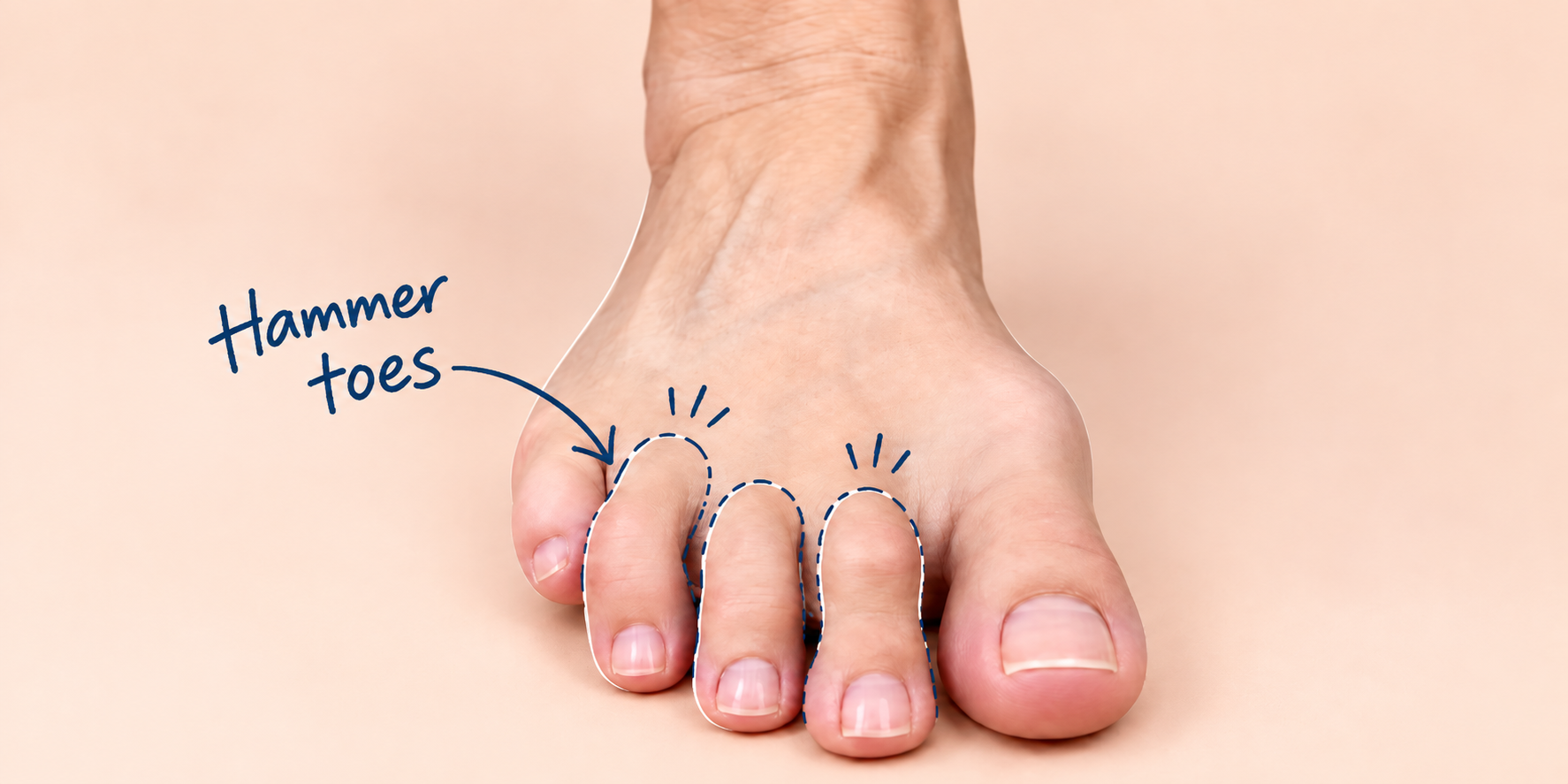
Close-up of a bare foot with hammer toes, highlighted by a navy blue hand-drawn arrow and outline annotations pointing to the curled middle toes on a soft beige background.
Published: 12 September 2026 | Last reviewed: 12 September 2026 

A hammer toe is a lesser toe deformity in which the middle joint bends downward, creating the familiar raised “knuckle” appearance. But not every curled toe is a true hammer toe: mallet toes, claw toes and crossover toes involve different joints and mechanical patterns. Hammer toes usually develop because the forces controlling toe position become unbalanced over time. Ageing, genetics, footwear, tendon imbalance, joint instability, hallux valgus and plantar-plate degeneration can all contribute. Early deformities may remain flexible, while longstanding ones can become structurally fixed as the soft tissues adapt. Treatment therefore depends on the cause and stage of the deformity, and may focus on reducing pressure, improving footwear, supporting unstable joints and managing the underlying biomechanics rather than simply trying to straighten the toe. 

Why Toes Curl, What Actually Causes Them and What You Can Do About Them

Look down at your feet.

Does one of your smaller toes no longer sit straight?

Perhaps the middle joint has started to rise. Maybe there is a hard corn over the prominent “knuckle”. Perhaps the end of the toe presses into the floor, or the toe has gradually started lifting away from the ground.

Most people call all of these changes hammer toes.

But medically, they are not all the same thing.

Hammer toe, claw toe, mallet toe and crossover toe describe different patterns of deformity. More importantly, the bent toe you can see may only be the final visible consequence of a mechanical process that began somewhere else in the forefoot.

That distinction matters.

The important question is therefore not simply:

“How can I straighten my hammer toe?”

It is:

“Why has this toe started changing position?”

What Exactly Is a Hammer Toe?

Each of the four lesser toes has three bones:
  • proximal phalanx;
  • middle phalanx;
  • distal phalanx.

Between them are the proximal interphalangeal (PIP) and distal interphalangeal (DIP) joints.

The toe connects to the foot through the metatarsophalangeal joint — the MTP joint.

Different combinations of abnormal joint position create different deformities.

Hammer toe

A true hammer toe is characterised predominantly by flexion of the PIP joint.
This produces the familiar raised middle “knuckle”.

Mallet toe

A mallet toe predominantly involves flexion of the DIP joint.
The tip of the toe therefore points downward and may develop callus, a corn or nail problems.

Claw toe

In a claw toe, the MTP joint extends upward while both interphalangeal joints flex downward.
The entire toe takes on a claw-like appearance.

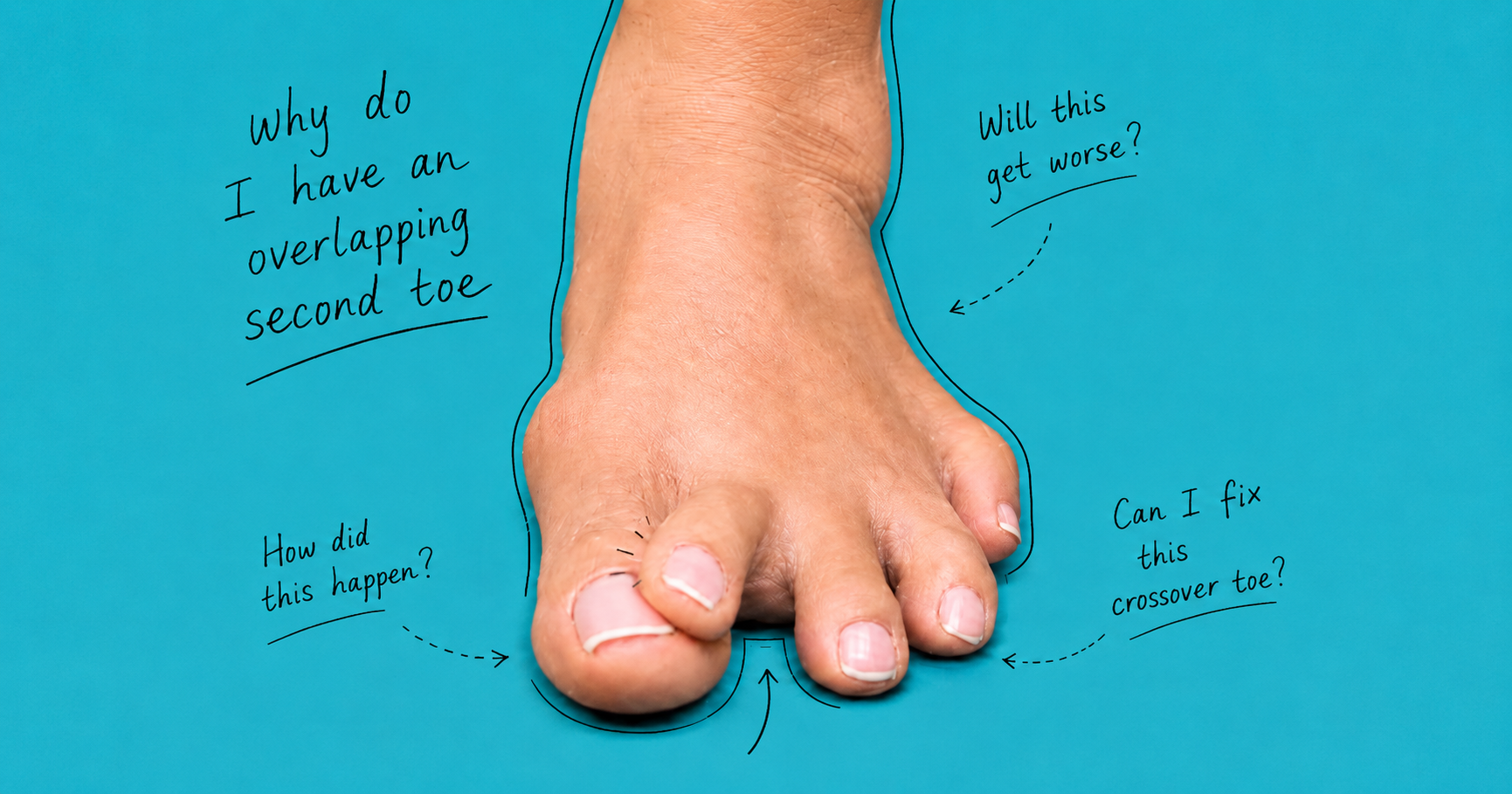
Crossover toe

A crossover toe involves instability and sideways displacement at the MTP joint.

The second toe is particularly susceptible and may progressively migrate toward — and eventually over — the big toe.

These distinctions are not merely terminology. They provide clues about which joints, tendons and stabilising structures are involved (Shirzad et al., 2011; Malhotra, Davda and Singh, 2016).

Hammer Toes Are Common — and Become More Common With Age

Lesser-toe deformities are extremely common.

In the Framingham Foot Study, lesser-toe deformities were present in approximately 29.6% of the population studied. Prevalence increased with age, and the researchers also demonstrated substantial heritability (Hannan et al., 2013).

This is important because it challenges the simplistic explanation that crooked toes are merely caused by wearing the wrong shoes.

Footwear matters.

But genetics, anatomy, ageing, joint stability and biomechanics matter too.

Why Does a Toe Start to Curl?

A straight toe is not held in position by one muscle.

Its alignment represents a balance between:
  • bones;
  • joint capsules;
  • collateral ligaments;
  • plantar plate;
  • flexor tendons;
  • extensor tendons;
  • lumbricals;
  • interosseous muscles;
  • plantar fascia; and
  • the mechanical forces passing through the forefoot.

When these forces remain balanced, the toe remains relatively stable.

When the balance changes, deformity can begin.

The intrinsic muscles normally help flex the MTP joints while extending the interphalangeal joints.

As the MTP joint becomes increasingly extended, these muscles become mechanically disadvantaged. The long extensor and flexor tendons can then increasingly dominate toe position.

The result can become a self-reinforcing deformity:

MTP extension
↓
changing tendon mechanics
↓
PIP flexion
↓
progressive soft-tissue adaptation
↓
fixed deformity

This is why an apparently simple hammer toe can actually represent a complex biomechanical problem (Shirzad et al., 2011; Malhotra, Davda and Singh, 2016).

The Plantar Plate Connection

Underneath each lesser MTP joint is a strong fibrocartilaginous structure called the plantar plate.

It forms an important part of the joint's stabilising system and helps resist excessive upward displacement of the toe.

If the plantar plate becomes attenuated or damaged, the MTP joint can become unstable. The toe may begin lifting or drifting, eventually contributing to hammer or crossover deformity.

But plantar-plate pathology is a substantial condition in its own right.

It can begin before a hammer toe is visible and sometimes before the patient is even aware that anything is changing.

For that reason, we explore the condition separately in our Complete Guide to Plantar Plate Degeneration and MTP Joint Instability.

Why Is the Second Toe So Frequently Involved?

The second MTP joint is particularly susceptible to instability.

The reasons are probably multifactorial and may include:
  • forefoot anatomy;
  • relative metatarsal length;
  • repetitive mechanical loading;
  • hallux valgus;
  • altered first-ray mechanics;
  • plantar-plate insufficiency; and
  • changing tendon forces.

This is why a progressively elevated or drifting second toe deserves more attention than simply calling it a “hammer toe”.

The Bunion–Hammer Toe Relationship

Bunions and second-toe deformities frequently coexist.

As hallux valgus progresses, the big toe migrates toward the lesser toes.

This changes the physical space available to the second toe and may alter the mechanical environment of the forefoot.

Eventually the second toe can become elevated, flexed or displaced.

In advanced cases it may cross over the big toe.

A bunion and second hammer toe should therefore not automatically be regarded as two completely unrelated problems.

Are Tight Shoes Really the Cause?

Footwear can certainly contribute.

A short shoe can force the toes into flexion.

A narrow toe box compresses them sideways.

An inadequately deep shoe causes the prominent PIP joint to repeatedly rub against the upper.

Higher heels also alter forefoot loading.

But footwear is only one part of the story.

The Framingham Foot Study demonstrated significant heritability of lesser-toe deformities (Hannan et al., 2013).

A better model is therefore:

genetic predisposition + anatomy + biomechanics + ageing + footwear + time

rather than simply:

tight shoes = hammer toes.

Flexible Versus Rigid Hammer Toes

This is one of the most clinically important distinctions.

Flexible

Early in the process, the toe can still be manually straightened.

The joint has not yet become structurally fixed.

Semi-rigid

The surrounding tissues begin adapting to the abnormal position and complete correction becomes progressively more difficult.

Rigid

Eventually the joint capsule, tendons and other soft tissues become contracted.

The toe can no longer be manually returned to a normal position.

This distinction determines what conservative treatment can realistically achieve.

A silicone device may reposition a flexible toe.

It may cushion a rigid toe.

Those are very different objectives.

Why Do Hammer Toes Hurt?

Interestingly, the crooked joint itself is not necessarily the main source of pain.

Pain over the top of the toe

A prominent PIP joint rubs repeatedly against footwear.

The skin thickens and a corn develops.

Sometimes an underlying bursa becomes inflamed.

Pain at the tip

Mallet and claw toes can push the distal tip of the toe into the ground.
This may cause:
  • callus;
  • corns;
  • nail trauma;
  • thickened nails; and
  • occasionally ulceration.

Pain beneath the ball of the foot

Abnormal toe position can alter loading beneath the corresponding metatarsal head.

Patients may therefore complain primarily of metatarsalgia.

Pain at the base of the toe

Pain around the MTP joint raises another possibility: instability, synovitis or plantar-plate pathology.

That deserves separate assessment.

Why Does My Corn Keep Coming Back?

Because the corn is usually the consequence of pressure.

Removing a corn removes thickened skin.

It does not necessarily remove the force that produced it.

If the same prominent joint continues rubbing against the shoe thousands of times each day, the skin responds by thickening again.

The better question is therefore:

Why is excessive pressure occurring here?

That may lead to a more durable solution.

Do Silicone Toe Straighteners Work?

Sometimes — depending on what you mean by “work”.

A silicone sleeve, crest pad, toe prop or custom digital orthosis may:
  • reduce friction;
  • cushion a prominent joint;
  • redistribute pressure;
  • improve comfort;
  • improve the position of some flexible toes.

But that does not mean the device permanently reverses the underlying deformity.

A recent review found that footwear modifications and orthoses can alleviate symptoms and reduce plantar pressure in selected lesser-toe deformities, although the evidence remains limited (Colò et al., 2025).

This distinction is important:

symptom improvement is not necessarily structural correction.

What About Exercises?

Exercises may help maintain:
  • mobility;
  • intrinsic muscle function;
  • coordination;
  • toe control; and
  • flexibility.

But evidence that exercise can reverse an established rigid adult hammer toe is lacking.

A contracted PIP joint is a structural problem.

Exercises can improve function without necessarily changing structure.

Choosing Shoes for Hammer Toes

Three dimensions matter.

Width

The toes should not be squeezed together.

Length

The longest toe should not repeatedly strike the end of the shoe.

Depth

This is frequently overlooked.

A shoe can be wide but still too shallow.

A hammer toe needs enough vertical space above the prominent PIP joint.

A wider and deeper toe box, adequate shoe length, cushioning and lower heel elevation form an important part of conservative treatment (Colò et al., 2025).

Do Orthotics Help?

Orthotics do not directly straighten a rigid hammer toe.

But they can sometimes address the mechanical environment around it.

They may be useful when deformity occurs alongside:
  • metatarsalgia;
  • abnormal forefoot pressure;
  • MTP instability;
  • prominent metatarsal heads;
  • hallux valgus; or
  • broader biomechanical abnormalities.

Metatarsal pads can reduce pressure beneath selected metatarsal heads, and cushioning can reduce peak plantar pressure (Colò et al., 2025).

The prescription should therefore address the mechanical findings, not simply the appearance of the toe.

When Should You Have a Hammer Toe Examined?

Consider assessment when:

  • the toe is progressively changing position;
  • it is becoming rigid;
  • corns repeatedly return;
  • footwear is becoming difficult;
  • pain develops beneath the ball of the foot;
  • the toe begins lifting;
  • a new gap develops between adjacent toes;
  • one toe begins crossing another;
  • there is swelling around the MTP joint;
  • numbness develops;
  • an ulcer occurs; or
  • you have diabetes or peripheral neuropathy.

One particularly important clue is change.

A toe that has looked the same for 30 years is different from one that has visibly moved during the past six months.

When Is Surgery Considered?

Surgery is generally considered when symptoms or functional problems remain substantial despite appropriate conservative treatment.

There is no single hammer-toe operation.

Depending upon the deformity, procedures may include:
  • tendon lengthening or transfer;
  • PIP arthroplasty;
  • PIP fusion;
  • metatarsal osteotomy;
  • MTP soft-tissue reconstruction;
  • plantar-plate repair; or
  • correction of associated hallux valgus.

The procedure should match the pathology.

K-Wires Versus Internal Implants

PIP fusion has traditionally been stabilised with temporary K-wires.

Numerous internal implants are now available.

A systematic review and meta-analysis found improvement with both approaches but did not demonstrate robust superiority of one over the other.

Considerable heterogeneity and limited high-quality comparative evidence remain (Butler et al., 2023).

Newer therefore does not automatically mean better.

The Most Important Point

A hammer toe describes what the toe looks like.

It does not necessarily tell us why it became that way.

A visible deformity may represent the endpoint of interactions between:

anatomy → joint stability → tendon balance → forefoot loading → footwear → progressive contracture

That is why treatment should not begin with:

“Which hammer-toe product should I buy?”

It should begin with:

“Why is this particular toe changing position?”

The Bottom Line

Hammer toes are common, but they are not all the same.

Some remain flexible and painless for years.

Others become progressively rigid.

Some primarily cause shoe pressure and corns.

Others occur because the MTP joint underneath the toe is becoming unstable.

Conservative treatment can be extremely useful for pressure relief, comfort and managing flexible deformity.

But a rigid structural contracture cannot realistically be expected to disappear because of a silicone separator or exercise programme.

The earlier a progressive deformity is recognised, the more useful the clinical question becomes:

What is driving the change — and can we modify it before the toe becomes fixed?


Book An Appointment

Disclaimer: The word "treatment" in this article refers to the care and management of a patient’s health to prevent, cure, or improve a condition. Treatment results vary and do not necessarily indicate a cure. This article is for informational and educational purposes only and does not constitute medical advice.

About the Author

Mark B. Reyneker, BTech (Podiatry), MSc (Palaeontology) is a podiatrist and Founder & Clinical Director of Family Podiatry Centre, with more than 25 years of clinical experience across South Africa, Malaysia and Singapore. His clinical interests include foot and lower-limb pain, gait and biomechanics, sports-related foot conditions, orthotic therapy and footwear.

Alongside his clinical practice, Mark conducts research into human gait and foot biomechanics. His MSc research at the University of the Witwatersrand investigated human propulsion and the structural properties of the metatarsals. He is also the inventor of A Foot Orthotic, an orthotic technology developed through an international patent family.

References

  1. Butler, J.J., Konar, K., Azam, M.T. and Kennedy, J.G. (2023) ‘K-Wire Fixation vs Implant Device Fixation for Hammertoe Deformity: A Systematic Review and Meta-Analysis’, Foot & Ankle Orthopaedics, 8(4).
    Original article: https://doi.org/10.1177/2473011423S00336

  2. Colò, G. et al. (2025) ‘The effectiveness of shoe modifications and foot orthoses in conservative treatment of lesser toe deformities: a review of literature’, Musculoskeletal Surgery, 109(3), pp. 225–232.
    Original article: https://doi.org/10.1007/s12306-024-00871-9

  3. Hannan, M.T., Menz, H.B., Jordan, J.M., Cupples, L.A., Cheng, C-H. and Hsu, Y-H. (2013) ‘High heritability of hallux valgus and lesser toe deformities in adult men and women’, Arthritis Care & Research, 65(9), pp. 1515–1521.
    Original article: https://doi.org/10.1002/acr.22040

  4. Malhotra, K., Davda, K. and Singh, D. (2016) ‘The pathology and management of lesser toe deformities’, EFORT Open Reviews, 1(11), pp. 409–419.
    Original article: https://doi.org/10.1302/2058-5241.1.160017

  5. Shirzad, K., Kiesau, C.D., DeOrio, J.K. and Parekh, S.G. (2011) ‘Lesser toe deformities’, Journal of the American Academy of Orthopaedic Surgeons, 19(8), pp. 505–514.
    Original article: https://doi.org/10.5435/00124635-201108000-00006

Frequently Asked Questions

A hammer toe is a foot deformity where a muscle, tendon, or ligament imbalance causes an abnormal bend in the middle joint (interphalangeal joint) of the toe. This forces the toe to curl downward into a claw-like or hammer-like shape instead of laying flat.

Hammer toes most frequently affect the second, third, and fourth toes. The second toe is particularly vulnerable, especially in individuals with long second toes or accompanying bunions on the big toe.

Early signs include a visible upward arching bend in the middle toe joint, pain or friction when wearing closed shoes, redness or swelling over the joint, and the development of painful corns or calluses where the raised joint rubs against footwear.

Hammer toe: Bends downward at the middle joint of the toe. Mallet toe: Bends downward specifically at the joint nearest the nail tip. Claw toe: Bends upward at the base joint where the toe meets the foot and downward at both smaller toe joints.

Hammer toes are primarily caused by a structural imbalance in the tendons and muscles of the foot. When the long stabilizing tendons work harder than the small intrinsic muscles—often due to poor foot biomechanics like flat feet, high arches, or overpronation—the tendons pull the toe joint into a bent position over time.

Footwear is a major contributing factor. Narrow, pointy shoes or high heels cramp the toes into a persistent bent position. While bad shoes may not be the sole root cause, wearing tight footwear accelerates muscle imbalances and locks flexible toes into permanent deformities.

Yes. A bunion causes the big toe to shift inward toward the second toe. This destabilizes the entire forefoot, forcing the smaller toes to contract and curl to make room or try to stabilize the foot during walking.

You don't inherit the hammer toe itself, but you do inherit your foot structure (such as low arches, flat feet, or hypermobile joints). These inherited mechanics make certain people significantly more prone to developing curling toes.

Flexible hammer toe: The toe joint can still be manually straightened or flattened out using your fingers. It is easier to treat non-surgically. Rigid hammer toe: The joint has become completely stiff, locked, or arthritic, making it impossible to straighten without surgery or advanced clinical intervention.

Yes. If left unaddressed, constant muscle contraction causes the joint capsule and surrounding tendons to shorten and tighten permanently, transitioning a flexible, treatable toe into a stiff, painful rigid deformity.

Yes! Flexible and semi-flexible hammer toes respond very well to non-surgical podiatric care. Conservative management focuses on correcting underlying biomechanical strain, offloading pressure points, rebalancing foot tendons, and stabilizing the arch.

Medical-grade custom foot orthotics address the root mechanical cause of the curling. By supporting the arch and controlling excessive pronation, orthotics relieve the abnormal tendon pulling that forces toes to buckle during walking.

Over-the-counter toe separators, gel caps, and splints can provide temporary comfort by reducing friction inside shoes. However, they only manage symptoms—they do not correct the underlying muscle and arch mechanics driving the deformity.

Gentle manual toe extensions, "towel curls" with your toes, picking up small marbles with your toes, and stretching tight calf muscles can help maintain tendon flexibility and strengthen the foot's small intrinsic muscles.

Look for shoes with a wide, deep toe box (to prevent the top of the bent joint from rubbing), soft flexible uppers (such as leather or mesh), low heels (under 1 inch), and removable insoles to accommodate custom orthotics.

A podiatrist can painlessly pare down or debride hard corns and calluses using sterile clinical instruments. They also provide custom padding or offloading orthotics so friction doesn't cause the corn to return. Never perform "bathroom surgery" with razor blades or harsh acid plasters at home!

Ignoring a hammer toe can lead to severe complications, including permanent joint rigidity, open sores or ulcers on top of the joint (a major risk for diabetics), forefoot fat pad displacement, and severe ball-of-foot pain (metatarsalgia).

Surgery is typically considered a last resort when the hammer toe becomes completely rigid, causes chronic unbearable pain, or develops open skin breakdown that fails to heal with conservative podiatric care.

Early intervention is key. Wearing wide, supportive shoes, getting an expert biomechanical assessment, using custom orthotics to rebalance tendon pull, and keeping joints mobile with physical therapy stretches are the best ways to stop progression.

You should visit a podiatrist as soon as you notice your toes beginning to curl, especially if you experience pain in closed shoes, form painful corns on top of the joints, or have diabetes or poor circulation.
All rights reserved | Blog